
Kingdom Kratom Product Guide: Powder vs. Capsules vs. Extracts
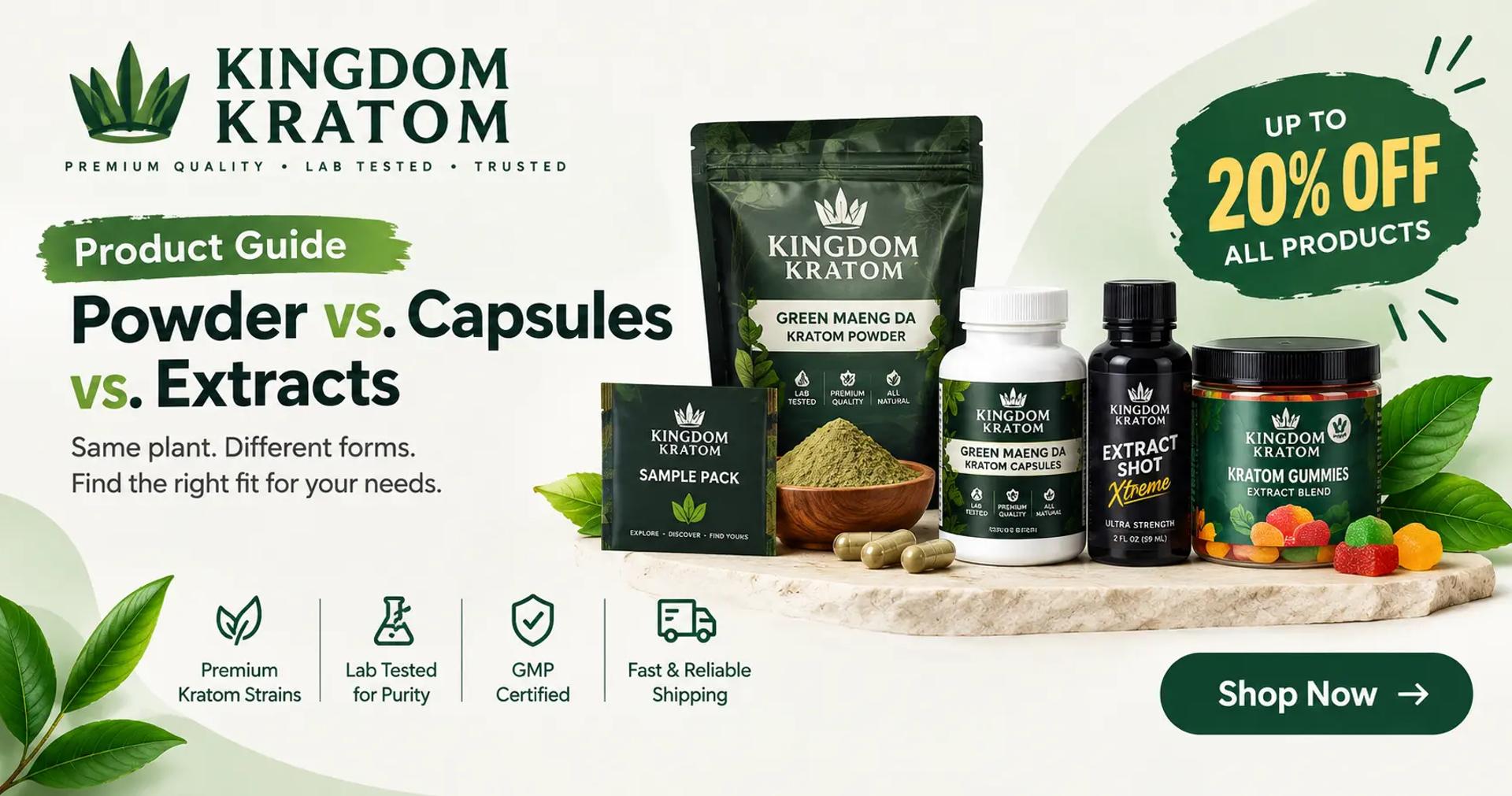
If you've landed on Kingdom Kratom's site, you've probably noticed the same product shows up in three or four different forms: powder, capsules, extract shots, gummies. That's not padding; it reflects genuinely different ways of packaging the same base material, and the right one depends on what you value: cost, convenience, or concentration.
This guide breaks down how Kingdom Kratom's main product categories differ, what the brand reports about its sourcing and testing, and what to check before you buy without telling you which one is "best," because that depends entirely on your own priorities and circumstances.
Question: What's the difference between kratom powder, capsules, and extracts? Direct answer: Powder is the ground leaf material in its rawest sold form; capsules are that same powder pre-measured into a swallowable format; extracts (shots, gummies, gel caps) are concentrated preparations intended to deliver more compound per serving in a smaller volume.
Kratom Powder
Kingdom Kratom's powder line includes strains like Green Maeng Da, White Maeng Da, Red Bali, Red Maeng Da, and Super White Borneo, sold in bag sizes ranging from small trial amounts up to bulk quantities. Powder is typically the least processed and often the lowest cost-per-serving format, but it requires the buyer to measure their own servings, and taste/texture is a common complaint among powder users generally.
Kratom Capsules
The same strains are also sold pre-portioned into capsules (Green Maeng Da, Red Maeng Da, White Maeng Da, Red Bali, plus proprietary blends like "Boost White Blend" and "Bliss Green Blend"). Capsules trade some cost-efficiency for convenience and consistency of serving size, and they avoid the taste issue entirely since nothing is dissolved or mixed.
Kratom Extracts
This is Kingdom Kratom's most varied category: extract gummies, liquid "shots" (including a higher-strength "Xtreme" version), flavored extract sticks ("Kingdom Burst"), gel capsules, and full-spectrum extract capsules in blister packs. Extracts are processed to concentrate specific compounds, which generally means a smaller serving delivers a stronger effect than an equivalent amount of raw powder. This is a structural difference in processing, not a claim about outcomes for any individual user.
Sample Packs
For anyone unsure which strain or format suits them, Kingdom Kratom offers sample packs across both powder and capsule lines, letting buyers try three or four strains at once rather than committing to a full bag or bottle of a single variety.
| Format | Convenience | Cost per serving (typically) | Best for |
|---|---|---|---|
| Powder | Requires measuring/mixing | Generally lowest | Buyers comfortable measuring their own servings |
| Capsules | Pre-measured, no taste | Moderate | Buyers who want consistency and portability |
| Extracts | Pre-measured, concentrated | Generally highest | Buyers seeking a smaller-volume, higher-potency format |
| Sample packs | Variable | Bundled discount vs. individual purchase | First-time buyers comparing strains |
What to Check Before Buying Any Format
- Lab results (COA): Kingdom Kratom states its products are tested in an FDA-registered laboratory. Look for a certificate of analysis (COA) that discloses alkaloid content and screens for contaminants.
- GMP certification: The brand reports GMP certification, which relates to manufacturing process consistency; it is not the same as FDA approval of the product itself, since the FDA has not approved kratom for any medical use.
- Return/refund policy: Kingdom Kratom reports a replacement-or-refund policy for orders the buyer isn't satisfied with.
- Local legality: Kratom is not legal everywhere. Some U.S. states, cities, and countries restrict or ban its sale, and some states set minimum purchase ages; check your local law before ordering.
- Personal health factors: Anyone pregnant, nursing, managing a medical condition, or taking prescription medication should speak with a healthcare provider before considering any kratom product, per warnings the brand itself discloses.
A Note on Reviews
Kingdom Kratom reports more than 21,000 five-star reviews on its site. That figure is brand-reported, not independently audited, and should be treated as one data point among several, not a substitute for checking a product's actual lab results.
Safety and Legal Context
The kratom industry is not federally regulated in the same way pharmaceuticals are. The FDA has issued repeated public warnings about kratom's opioid-like effects, potential for dependency, and lack of approved medical use, and has taken enforcement action against vendors making unsubstantiated health claims. Regulatory attention has also extended to concentrated kratom compounds like 7-OH, which the DEA moved to restrict in 2026. This doesn't mean every product is unsafe, but it means the category carries more regulatory uncertainty than an average supplement, and buyers should factor that into any purchase decision.
Frequently asked questions
Extracts are processed to concentrate specific compounds, so a given serving size of extract typically delivers more concentrated material than the same volume of raw powder. That's a difference in processing, not a guarantee of any particular effect.
Capsules are portioned by the manufacturer to a consistent per-capsule amount, which the brand should disclose on the product label or listing. Check the specific product page for exact figures.
GMP (Good Manufacturing Practice) certification relates to consistency and quality control in the manufacturing process. It does not mean the product has been evaluated or approved by the FDA for safety or effectiveness.
Sample packs let you compare multiple strains or formats without committing to a full-size purchase of each, which can be useful if you're undecided, though they don't reduce any of the legal or health considerations that apply to a single product.
The brand states orders placed by 1 PM Central Time ship the same day; confirm current cutoff times directly on the site, since policies can change.
About the author
Noah Kingsley
Food & Wellness Research Writer
Noah researches food brands, supplements, beverages, and wellness products. His articles explain ingredients, product positioning, and real-world value in a straightforward, reader-friendly way.
View All Posts