
Is Regenerative Organic Meat Delivery Worth It? A Look at StarWalker
Pick up a package of meat at most stores, and you're often buying blind. Where did the animal live? What did it eat? Was the pasture sprayed? Nine times out of ten, the label won't tell you, and that uncertainty is exactly what pushes people toward regenerative organic meat delivery in the first place. If you've reached the point where "cheap and mystery-sourced" no longer sits right, this article is for you. Below, I'll walk through what StarWalker Organic Farms offers, the honest trade-offs, and how to decide whether it earns a spot on your table.
The Problem: You Can't Trust What You Can't Trace
Conventional meat shopping asks you to take a lot on faith.
The packaging rarely reveals how the animal was raised, what chemicals touched its feed, or whether it ever saw open pasture. Vague terms like "natural" don't carry a legal guarantee. So you're left guessing, and guessing about food you feed your family gets old fast.
That's the real frustration. It isn't only about taste. It's about wanting confidence that what you buy matches what you value.
The StarWalker Solution: Certified From the Soil Up
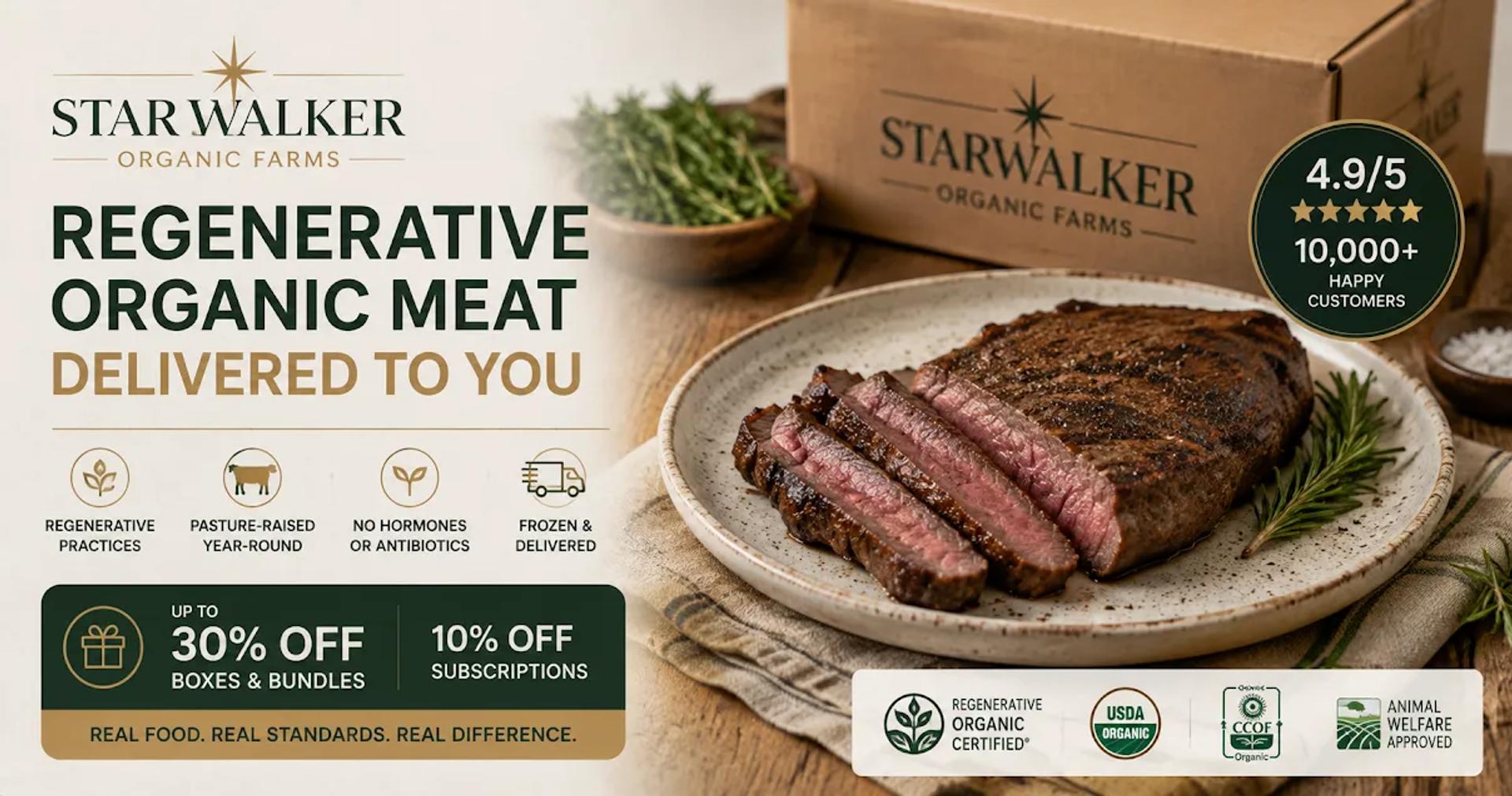
StarWalker Organic Farms tackles that trust gap head-on. The brand describes itself as the first Regenerative Organic Certified® meat producer in the U.S., built on the philosophy of "creating health from the soil up."
Rather than asking you to trust a marketing slogan, StarWalker leans on third-party standards. Its site-listed certifications include Regenerative Organic Certified®, USDA Organic, CCOF, and Animal Welfare Approved. Together, these labels do the verifying so you don't have to squint at vague packaging.
There's also a human story behind it. According to the brand, the Walker family has farmed since 1970 and now runs a third-generation operation in California. That longevity signals a farm invested in the long game, not a quick label swap.
What You Actually Get: Features That Matter
A certification list only helps if it translates into real benefits. Here's how StarWalker's approach breaks down.
Pasture-Raised, Year-Round
- Feature: Animals graze healthy pastures 365 days a year, with zero confinement.
- Benefit: No feedlot finishing, which aligns with the brand's animal-welfare positioning.
- Reader outcome: You buy meat raised in a way that matches how you'd want animals treated.
Clean Inputs, No Shortcuts
- Feature: No pesticides, herbicides, antibiotics, or added hormones, according to the brand.
- Benefit: Fewer of the inputs many shoppers actively try to avoid.
- Reader outcome: Peace of mind about what isn't in your food, backed by organic certification.
Nutrient Positioning
- Feature: StarWalker states its meat contains higher omega-3s, CLA, and minerals.
- Benefit: A nutrition-forward option compared with conventional meat.
- Reader outcome: If nutrient density matters to you, it's part of the pitch, though treat this as a brand claim rather than a clinical guarantee.
Frozen, Tracked Delivery
- Feature: Orders are hand-packed, shipped with dry ice, guaranteed frozen, and tracked.
- Benefit: Farm-quality cuts arrive at your door without a trip to a specialty butcher.
- Reader outcome: Convenience without sacrificing the sourcing standards you care about.
Want to see the current lineup? Explore StarWalker's current cuts and bundles.
The Proof Behind the Pitch
Claims are easy. Here's the supporting context StarWalker provides, framed as brand-reported.
The site shows a 4.9/5 rating from 10,000+ customers, with feedback themes centered on value, careful packaging, and trust in the meat's quality. StarWalker also displays media mentions from outlets including Forbes, USA Today, and Food Network. Treat those as logo placements rather than product endorsements unless stated otherwise.
The certifications carry weight too. Because bodies like the Regenerative Organic Alliance and USDA set the standards, they add independent structure to what would otherwise be self-reported quality.
Handling the Honest Objections
A confident recommendation shouldn't dodge the tough questions.
"Isn't it expensive?" Yes, premium sourcing costs more. Listed examples include a Flat Iron Steak around $18 and a Beef Brisket half near $40, though prices change. The value proposition is what those dollars buy: certified, traceable, pasture-raised meat.
"How do I keep the cost reasonable?" Bundles help. StarWalker lists boxes and bundles at up to 30% off, plus 10% savings when you subscribe. For regular buyers, those two levers soften the premium.
"What if I don't want a huge commitment?" You don't have to buy a half cow. Individual cuts and grab-and-go snacks let you start small before scaling up.
Honest Pros and Cons
Pros
- Backed by four site-listed certifications, including Regenerative Organic Certified
- Pasture-raised year-round with no feedlots, per the brand
- Free of pesticides, herbicides, antibiotics, and added hormones, as stated
- Strong reported social proof at 4.9/5 from 10,000+ customers
- Flexible options: individual cuts, bundles, subscriptions, and snacks
- Frozen, tracked, dry-ice shipping for farm-to-door convenience
Things to consider
- Premium pricing sits above conventional supermarket meat
- Frozen delivery requires freezer space and some planning
- Nutrition claims are brand-stated, not presented as clinical proof
- Some items, like Filet Mignon, may be sold out at times
- A subscription is a recurring commitment worth reviewing first
A Quick Buying Guide
Match your priority to the right entry point.
Just Testing the Waters?
Start with a couple of individual cuts, like a New York Strip or Flat Iron Steak. It's the lowest-risk way to judge quality for yourself.
Feeding a Family Regularly?
A curated box or bundle usually delivers the best value, especially with the listed discounts of up to 30%. It stocks your freezer in one order.
Buying the Same Cuts Often?
A subscription makes sense here, trimming 10% every month and removing the reorder hassle.
Before ordering, confirm current pricing, availability, and shipping details, since promotions and stock shift.
Who It Suits, and Who Might Not
A strong fit if you:
- Want traceable, certified meat and value knowing your sourcing
- Care about regenerative farming and animal welfare
- Prefer doorstep delivery over hunting down a specialty butcher
You may prefer another option if you:
- Shop primarily on lowest price
- Have limited freezer space
- Want same-day, non-frozen meat from a local counter
The Bottom Line
Good meat should give you confidence, not questions. That's the core appeal of regenerative organic meat delivery, and where StarWalker aims to stand out.
You get certified, traceable, pasture-raised meat from a third-generation family farm, delivered frozen to your door. The pricing runs premium and the nutrition claims are brand-stated, so keep expectations grounded. But if traceability, animal welfare, and regenerative farming top your list, the certifications and flexible ordering make it easy to try without overcommitting.
When you're ready to weigh it for yourself, browse StarWalker's current cuts and bundles and pick the option that fits your table.
Frequently asked questions
It's a service that ships meat raised using regenerative organic farming, then delivers it to your door. StarWalker, for example, describes itself as the first Regenerative Organic Certified® meat producer in the U.S., pairing soil-building practices with frozen, tracked shipping so certified cuts reach you directly.
According to the brand, yes. Its site lists Regenerative Organic Certified®, USDA Organic, CCOF, and Animal Welfare Approved certifications. These third-party standards add independent structure to the brand's quality claims, which is part of what separates it from vaguely labeled conventional meat.
StarWalker states that orders are hand-packed, shipped with dry ice, guaranteed frozen, and tracked throughout transit. That approach is designed to keep cuts frozen from the farm to your doorstep, so you can move them straight into your freezer on arrival.
It depends on your habits. One-time cuts suit occasional buyers who want to test quality first. A subscription suits repeat buyers, since StarWalker lists a 10% monthly saving. If you order the same cuts regularly, the discount and convenience usually justify it.
The premium reflects the farming model: pasture-raised animals, no feedlots, and no synthetic inputs, all verified by certification. That's more expensive to produce than conventional meat. Bundles at up to 30% off and subscription savings can help offset the higher price for regular shoppers.
Yes. StarWalker offers individual cuts and grab-and-go snacks alongside larger boxes and bundles. That flexibility lets you start with a single steak or two, judge the quality yourself, then scale up to bundles or a subscription only if it's a fit.
About the author
Noah Kingsley
Food & Wellness Research Writer
Noah researches food brands, supplements, beverages, and wellness products. His articles explain ingredients, product positioning, and real-world value in a straightforward, reader-friendly way.
View All Posts